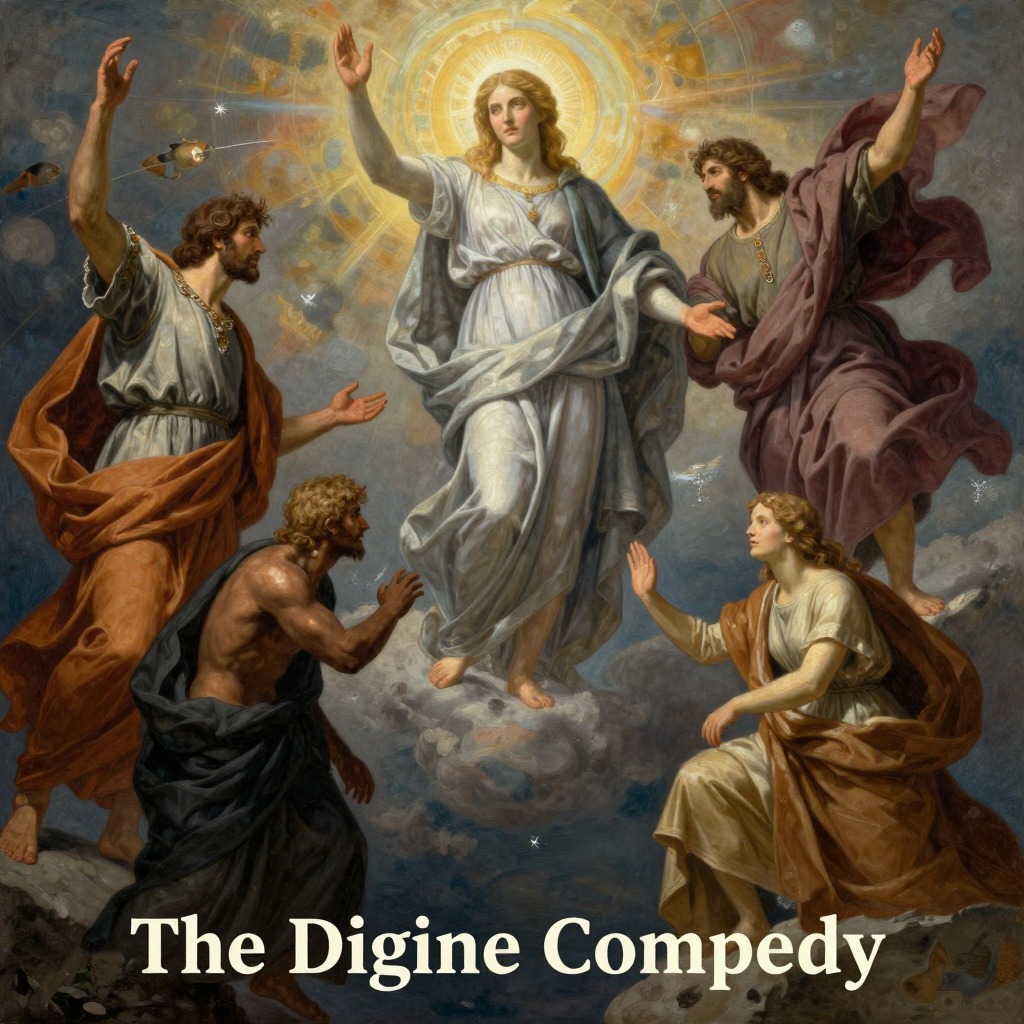
Cacciaguida and Dante
Cacciaguida, Dante's great-grandfather, appears to the pilgrim in the sphere of Mars, the fifth heaven, where the souls of martyrs and crusaders who died fighting for the true faith shine within the celestial cross. Their encounter is the emotional and prophetic core of the Paradiso, grounding Dante's cosmic journey in personal history and political reality. Cacciaguida reveals the poet's noble ancestry, foretells his bitter exile from Florence, and commissions him to write the Divine Comedy as a work of uncompromising truth.
Identity and Ancestral Revelation
Cacciaguida identifies himself as Dante's great-grandfather, a man who was born in Florence, baptized in the ancient Baptistery of San Giovanni, and later knighted by the Emperor Conrad. He followed Conrad on crusade against the "law's iniquity" and died a martyr, thereby earning his place among the blessed in Mars. He tells Dante that his own father was named Alighiero, and that the family surname derives from Cacciaguida's wife, who came from the Val di Pado. He describes the Florence of his youth as a city of "quiet, temperate and chaste" citizens, living within its ancient boundaries, where women did not wear gaudy ornaments and men were content with simple leather and bone. This idealized portrait of the old city contrasts sharply with the corrupt, faction-ridden Florence Dante knows.
Prophecy of Exile and Suffering
Cacciaguida delivers the most detailed and personal prophecy of Dante's future suffering. He tells Dante that he must leave Florence, just as Hippolytus was driven from Athens by a false stepmother. The exile will be willed and sought by those who "every day the Christ is bought and sold" — a reference to the corrupt papacy of Boniface VIII. Dante will be forced to abandon everything he loves most tenderly, and he will experience the bitterness of "another's bread" and the hardship of "going down and up another's stairs." His companions in exile will prove "ingrate, all mad and impious," turning against him, but they will be the ones to bear the shame. Cacciaguida advises Dante to make a party of himself alone, and promises that his first refuge will be with the "mighty Lombard" Bartolomeo della Scala of Verona, who bears the holy bird (the imperial eagle) on his ladder. He also speaks of Bartolomeo's younger brother, Can Grande della Scala, then only nine years old, who will become a figure of great virtue and power, and whom Dante should rely upon.
Commission to Write the Truth
Dante, having heard the prophecy, expresses his fear that speaking the full truth in his poem might make him enemies and cost him his life. Cacciaguida responds with a powerful mandate: Dante must lay aside all falsehood and make his vision "manifest utterly." He compares the poet's words to the wind that strikes the highest summits, making such attack a sign of honor. He explains that the souls shown to Dante — those in Hell, on the Mount of Purgatory, and in the wheels of Heaven — are only those known to fame, because the reader's spirit rests not on an example whose root is hidden. This instruction gives Dante the moral authority to write a poem that will offend the powerful but ultimately serve as "vital nutriment" after its initial bitterness.
Thematic Significance
Cacciaguida's role is to connect Dante's personal destiny with the universal themes of justice, exile, and poetic vocation. He is the voice of ancestral wisdom and the embodiment of the old Florentine virtues that Dante mourns. His prophecy transforms Dante from a private pilgrim into a public poet-prophet, charged with recording what he has seen for the salvation of others. The encounter also establishes the legitimacy of Dante's political critique: Cacciaguida, a martyr and a knight, speaks with the authority of one who has seen God and who knows the true history of Florence. His words give Dante the courage to write a poem that will be "a savour of strong herbs to many," a work that will endure beyond the petty politics of his time.